Super Quests: MEC Inhibitory Interneurons
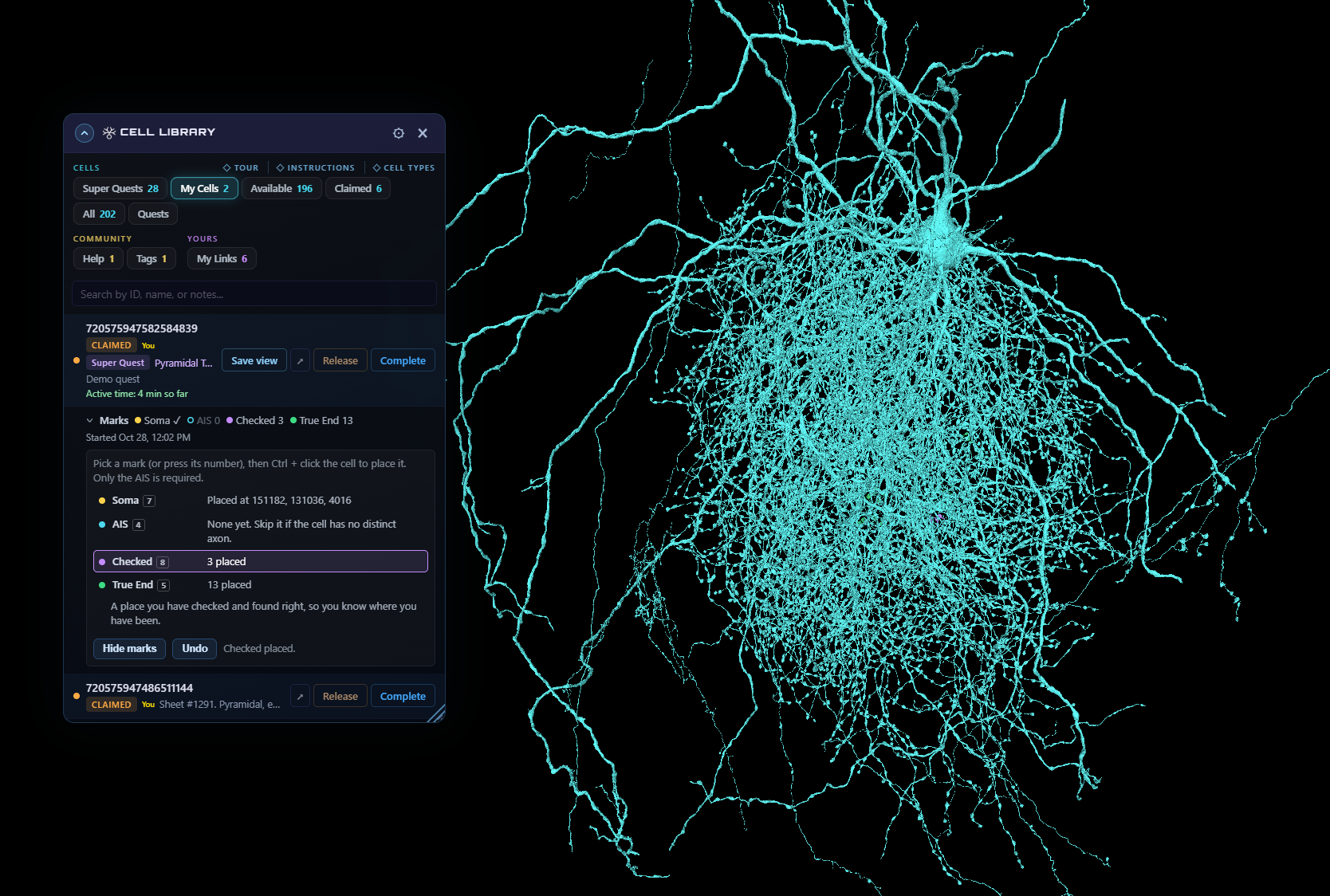
Some neurons ask for an afternoon. These could keep you exploring for weeks.
We’re introducing Super Quests in Pyr: a chance to help map enormous inhibitory interneurons in the medial entorhinal cortex (MEC), a brain region involved in navigation and memory.
The medial entorhinal cortex helps the brain keep track of where you are. It is home to grid cells, which fire in a regular pattern as an animal moves through space. Interneurons are the cells that hold that activity in check: they inhibit their neighbors, and the giant ones reach a great many of them.
The new Super Quest features giant interneurons of the MEC. Each has so many branches that it can take weeks to finish. Nobody has mapped these cell types before. You can be among the first to see one whole and help us decipher what they do!
A precise question: who do they inhibit?
The lab has selected 29 cells and grouped them by their predicted targets:
- Pyramidal Target — 17 cells: predicted to inhibit pyramidal neurons exclusively.
- Non-Pyramidal Target — 12 cells: predicted to inhibit non-pyramidal cells exclusively.
Those are predictions. Your proofreading will help us reconstruct these neurons and analyze their connections to find out whether the predictions hold.
How a Super Quest works#
Open the Cell Library on MEC and pick the Super Quests chip. You may claim one at a time and keep it for up to two months (if you need longer, just message us). A Super Quest sits beside your other claims and does not count against them.
Marks. Mark the AIS, where the axon leaves the cell; it is the one mark that is required. Others are optional. You could use True End for a branch that stops naturally, and Checked for a place you have looked at and found right, so you know where you have been. Hide marks clears them from the view when you want to see the cell itself. We are working on Highlight mode in MEC. For now, annotations highlight the immediately surrounding area on a cell, so you can add lots of annotations to effectively highlight a branch.
Your time is counted. This is how the lab learns how long these cells really take and will help us estimate the amount of time required for proofreading in this and future datasets. Pyr adds up your active time on the cell and shows it on the row, such as 14 h 20 min so far. It counts only while the cell is on screen, Pyr is the tab in front, and you have used the mouse or keys in the last 5 minutes. There is no need to hurry. It is most important to map the cells accurately.
"Save view" keeps your layers and marks with the claim, and the claim keeps the cell's ID through every merge and split.
A special achievement is waiting for anyone who accurately completes a Super Quest. Prefer something lighter? Try mapping MEC pyramidal axons. Guaranteed only moderately difficult!
Thank you for contributing to neuroscience!